
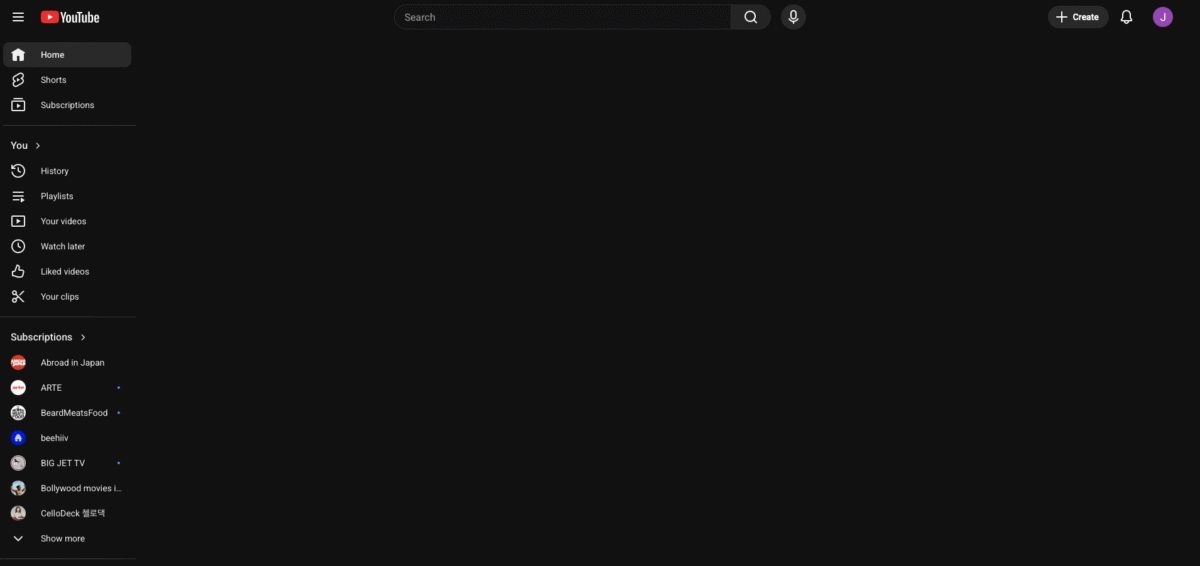
A few years ago I did an audit of how I spent my time and unsurprisingly I spent a lot of time on social media and Youtube. And Youtube was way ahead by miles. Ask me what I had watched yesterday and I could not tell you beyond 1 or 2 videos. Ask me what I had learnt a week later and I could not tell you anything. True, some videos were interesting. It made me want to buy an iPad and a new phone. And try new projects. I go the iPad and new phone but the projects that I wanted to try didn’t even get a start beyond 2-3 hours of initial planning.
At that time, Youtube also started feeling like it was not a nice place to be. For me, at least, it made me want to visit many countries which was not possible. And at the end of some videos, it genuinely felt like I had wasted my time watching it. Worse of it all are suggestions on the right of the screen. The click bait titles and thumbnails. The optimised video to keep your attention but at the end learn nothing. It all felt a bit of a waste of time and not very entertaining.
I did, however, come across many videos about Japan. I love that country and it was through searches that I found three really good channels that I watch even today. But the point is that it was through search and not via suggestions or autoplay. The algorithm, I think, did not play much of a role in it. In the things that I liked, the algorithm didn’t help much. But in the things that felt deflating, the algorithm did play a huge part.
So I researched around and found a few solutions. I knew I could not erase Youtube totally but I wanted to minimise as much as possible its algorithmic influence. I ended up doing these steps:
(1) Cleared my history on my account. All of it. Without history, the system cannot really optimise what to show me.
(2) Installed an add-on called Focus. It blanked all suggestions.
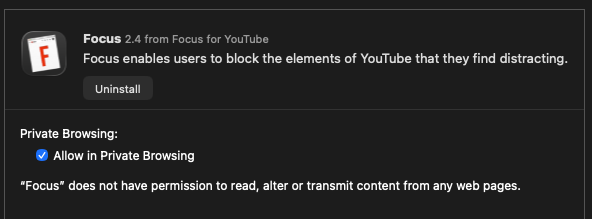
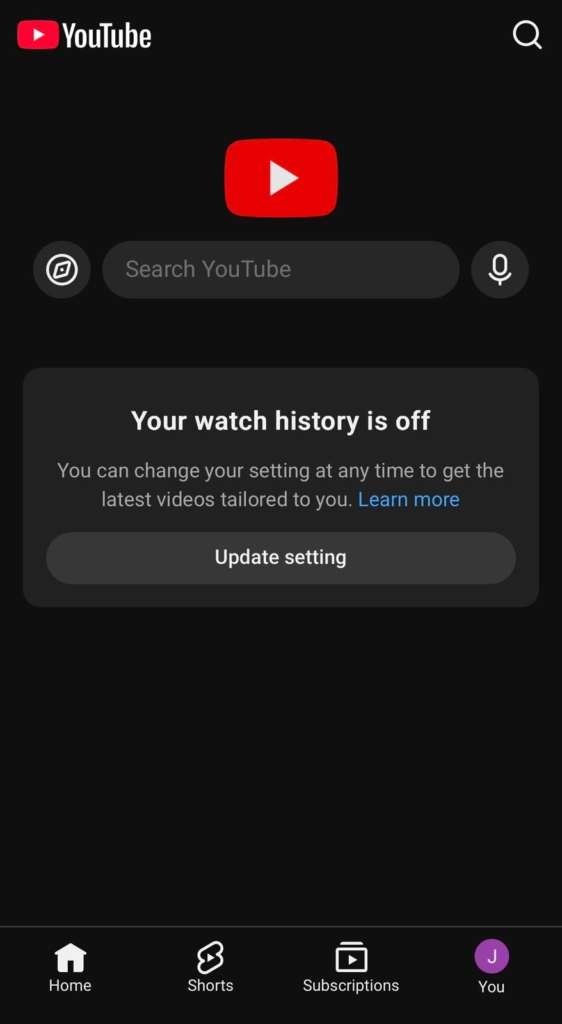
Basically now, I only see videos on the subscriptions tab. Shorts I do not even watch. And unless I search something specific, I do not get any videos to watch. And that is across all my devices. I do not have the app on my phone, so I have to use the browser which makes the experience less appealing.
YouTube seems to be catching up on this trend though. A recent update makes autoplay next videos an automatic feature which the blocker apps have not yet updated to stop. In addition, the wait time for autoplay of the next video to start seems to have been reduced giving less of a chance to the user to stop the autoplay. There are of course other apps in this space which provides users greater control over what they see and how to focus their attention. And it seems to be a growing area of app development.
Brain Rot to the square
Brain rot was the oxford word of the year in 2024 signalling a realisation by social media and content consumption users that their time is valuable but also their mental faculties are diminishing as a result. They say that very old people eat healthy but also think healthily – keeping their mind occupied in productive ways.
I worry about my own increasing usage of AI. Need to know a code : Use AI to help. Need a rough structure for a cover letter: Use AI to help. Need to understand a term in mathematics; use AI to help. I recently had a second round interview for a potential analyst position with a candidate who had shown potential. At some point in the interview, where she was meant to present her findings on three questions, she started reading her own slides discovering what had been written. Despite answering a few tricky questions well, it nevertheless, caused her to be eliminated from the process. It is very easy to fall into the rotting slope without proper self-realisation of our own AI use.
Depending on how we use AI, it can either lead to brain rot to the square or it can actually help us learn more. I can imagine websites and apps popping up which use AI to help ageing people keep up their mental faculties. But who will guide us ? and will it be appealing enough to create a healthy usage ?
I suppose, like previous technologies such as the telephone and TV, society will learn to regulate its own usage with time. Experimentation and discovery has always been part of the human approach. The pace of technological development though is increasing the need for this adoption phase to be much faster. Whereas the telephone and fax were introduced over a period of half a decade without any competing attention seeking technologies, today’s tech requires us to adopt much faster. Social media platforms like facebook took a decade to become widely used and form part of the social fabric. AI will be much faster (if the AI bubble does not pop) and the next attention seeking technology after the AI will probably give us less time to adapt. Governments and regulatory institutions seem to be only starting to think of those questions.
4 Years partially offline
While I try to use my time more consciously and focused, I nevertheless keep getting bombarded with attention seeking technologies. Lately emails have been filling up my multiple inboxes. Some of those newsletters are genuinely interesting to read. Lately I’ve been experiencing with trying to create time blocks to read a couple of those newsletters or articles. The inbox has been for a while now a battleground between advertisers, content creators and email providers who are offering more and more sophisticated tools to keep their inbox clean and unsubscribe more easily to unwanted subscriptions.
As for podcasts, I only listen to a selectively few of those. For me personally, a few years ago, I had a long drive to work in the morning. What an absolute great time to listen to podcasts to learn and think. Great. The side effects? I found myself reaching work 45 – 60 minutes later and still thinking about what I had listened. It took me another hour or so to fully change the focus of my mind to work. And of course, some days, the content of podcasts seemed to be more interesting than the repetitive nature of work which made it even harder to switch. Luckily I stopped those long drives and as a rule now, I try not to listen to anything too stimulating in the morning even for a short drive.
Twitch had become a substitute to YouTube for a while. It was live and I could communicate with the content creator in live and sort of change the course of the conversation by asking questions. It was a useful white noise at times as well. Slowly though, as life and work got more intense, Twitch also faded away. Long streams in Japanese time made it hard for me to keep up. And slowly I lost interest. Even on weekends now, I rarely would watch a stream in full. I can watch bits and pieces.
It seems then that it’s a never ending battle with technology. Even though I do not listen to local news and am not on any social media; I still end up being briefed by my friends from time to time about what’s going on in the country. Of course, I do not know full details but I do get the equivalent of the front page with a very rich deep dive once in a while.
The future of Blank screens
The future then seems to be a never ending battle between our attention and technologies trying to grab it. I remember when I was young wanting a similar device to that of the ninja turtle. The one-eye glass in Dragon Ball Z made it even more appealing; yet possibly creepy to be able to know everything about anyone just by a scan. Today’s AI capabilities are the closest we’ve been to getting Iron Man’s Jarvice. Sold as a dream, all those three devices seem very appealing to the human. At a time when it was hard to communicate with your best friend constantly, the ninja turtle’s communication device looked very appealing. Today the etiquette of WhatsApp is a taboo discussion. The Google glass made a foray but was too early for its time. Socially weird and a not yet mature technology. The Apple Vision Pro seem to sadly follow the same path. Today’s AI, our Jarvice, is very prone to errors requiring sometimes more time to do a task than letting the AI do it.
The next few years will bring even more technologies to humans. Deeply brain implanted rods which can translate our thoughts to robotic actions seem to be the next technology coming. Imagine, on top of having our attention, technology will now be able to grab our thoughts. Dictate it at its source.
Attention grabbing technologies look very appealing when the world seems boring. Yet when they become mature, these technologies make us yearn for clam and quiet. Gardening in peace. Paying elite numbers to be able to hide away in the forest for a few days. Those do not last long though. Our yearning to be connected and to be exposed to information seems to be biologically inbuilt in us. Airlines are not insensitive to this. They are investing massively in connecting their planes reliably for the duration of flights. And passengers seem to be very willing to pay for it. In the end then, our relationship with attention grabbing technologies seem to follow our relationship with fashion. Love it today; bored of it tomorrow yearning for something new and in a few years revisiting what we got bored of. This biological faculty of ours is what makes economies run now and in the future.